
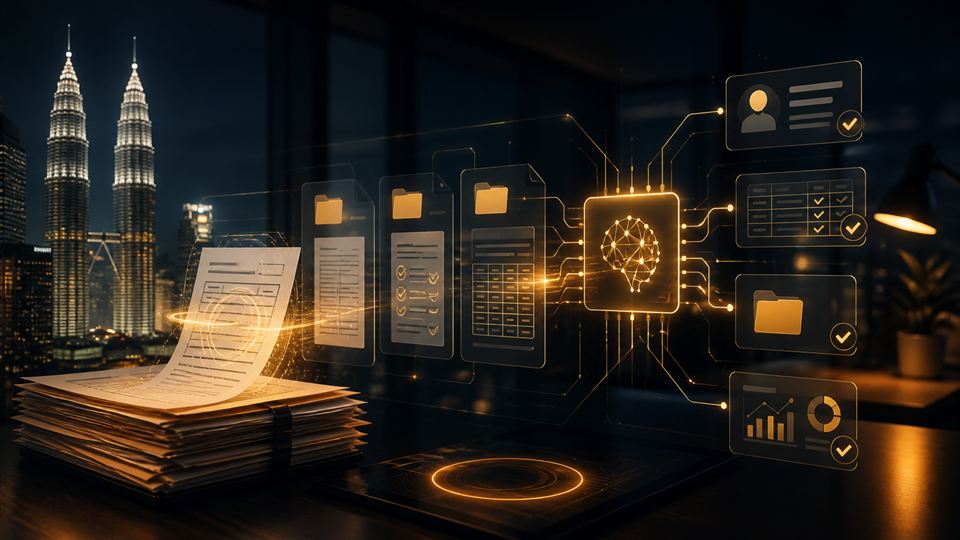
The real AI adoption in Malaysia is not chatbots. It is this.
Ask anyone about AI, and the answer is usually quite predictable.
Chatbots.
Customer service bots, ChatGPT-style assistants, website pop-ups that say "How can I help you today?"
That is the visible side of AI. But in Malaysia, I think the more interesting adoption is happening somewhere quieter.
Behind the scenes.
Inside workflows.
We have been looking at AI the wrong way
The chatbot conversation is loud because everyone can see it.
You open a website, a bot appears. You ask a question, it replies. Easy to understand.
But for many Malaysian companies, especially in banking, insurance, and enterprise operations, AI is not mainly being used to talk to customers.
It is being used to remove friction.
Not glamorous, but very valuable.
AI in Malaysia is becoming operational
Think about the boring-but-expensive work that happens every day:
- processing insurance claims
- reviewing internal approvals
- checking compliance documents
- sorting customer cases
- handling document-heavy workflows
These are not the kind of problems that get viral LinkedIn posts.
But they are real business problems.
When a process is repeated thousands of times a month, even a small improvement can save serious time and money.
The shift is from conversation to workflow
Instead of asking AI to only "respond", companies are starting to use AI to decide, route, extract, and process.
It looks like:
- emails being turned into structured tasks
- documents being extracted and validated automatically
- cases being routed to the right team without manual sorting
- exceptions being flagged before they become bigger problems
No chat window.
No fancy interface.
Just systems quietly working in the background.
Why this matters more than chatbots
Chatbots are useful, but workflows are where the real cost usually sits.
One inefficient internal process, repeated again and again, can create more drag than a single customer chat ever will.
Fix that, and you do not just improve customer experience.
You also:
- reduce operational cost
- improve turnaround time
- lower human error
- scale without hiring for every extra task
That is where AI starts becoming practical transformation, not just a feature demo.
Malaysia has the right kind of complexity
Malaysia is in an interesting position for this.
We have strong enterprise sectors, a lot of documentation-heavy work, growing regulatory requirements, and a bigger push toward digitalisation.
That creates a very natural environment for workflow-driven AI adoption.
Not AI for the sake of looking advanced.
AI because the process is too slow, too manual, or too expensive.
The reality most people miss
Many companies in Malaysia are already using AI.
They just do not always call it AI.
Sometimes it is hidden inside:
- internal tools
- backend systems
- integration layers
- automation pipelines
- fraud detection rules
- document processing systems
So while the public conversation is still focused on chatbots, the real progress is happening deeper inside operations.
Less obvious, but probably more important.
So what is "this"?
It is not one product.
It is a shift in mindset.
AI is no longer only something you interact with.
It is something your systems rely on.
That is a much bigger change.
Final thought
The companies that win with AI in Malaysia may not be the ones with the best chatbot.
They will be the ones that remove the most friction from their operations.
Faster claims. Cleaner approvals. Better routing. Fewer manual checks. Less repeated admin work.
That kind of AI adoption is not always exciting to look at.
But it is exactly where the real value is.